May 23, 2026 · Insights
Why Moving Fast Isn't Enough: How to Build a "System 2" for Your Startup
 Hadi Ismail
Why Moving Fast Isn't Enough: How to Build a "System 2" for Your Startup
In the startup and innovation world, teams are rarely short on activity. You are building, shipping, experimenting, and talking to users. But despite all this motion, many teams still struggle to answer the questions that matter most:
What are we actually learning?
How confident are we in this?
What should we do next?
Most teams do not fail because they cannot generate effort; they fail because their learning is scattered and decisions are made without structured evidence. Work moves forward, but conviction stays weak.
To understand why this happens and how to fix it, we have to look at how the human brain makes decisions.
The Two Systems of Thinking
In his groundbreaking book Thinking, Fast and Slow, Nobel laureate Daniel Kahneman explains that our minds operate using two distinct systems:
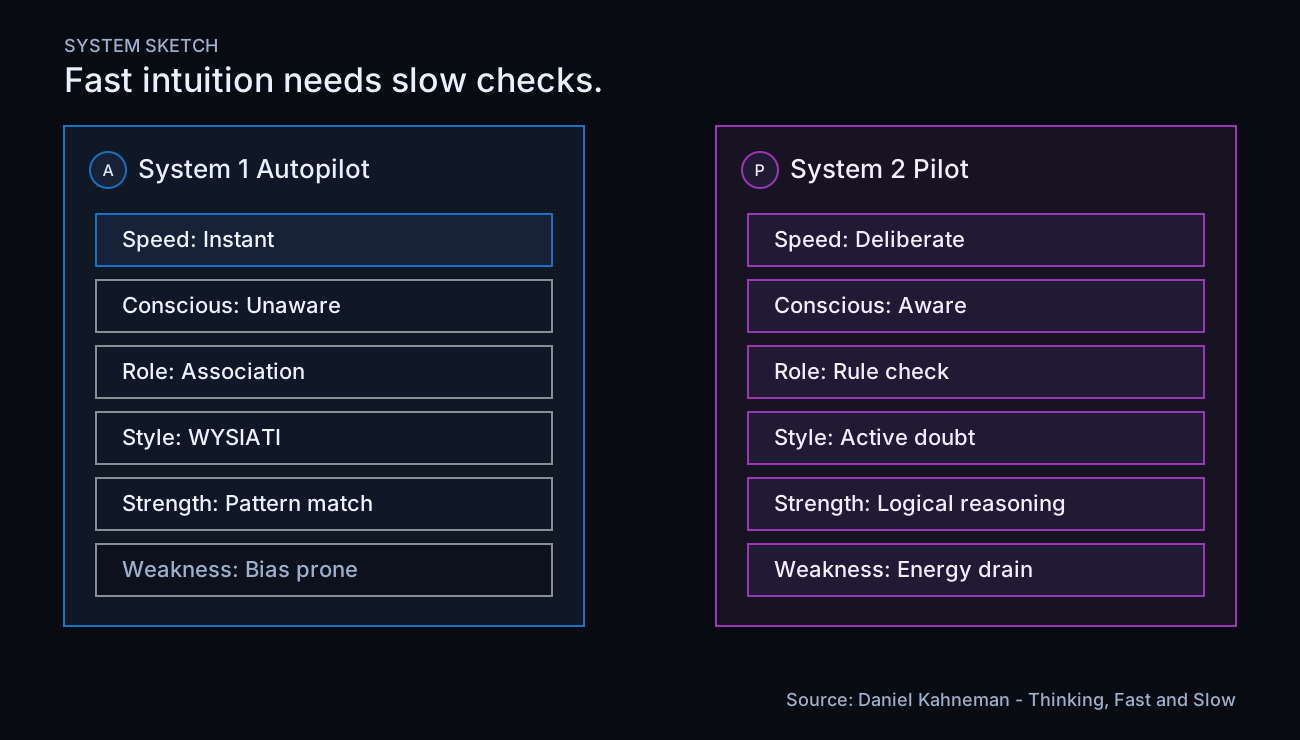
System 1 (Thinking Fast): This is our automatic, intuitive, and unconscious mind. It operates effortlessly and jumps to conclusions based on whatever information is immediately available. System 1 operates on a principle Kahneman calls "WYSIATI" (What You See Is All There Is), meaning it easily spins a confident story out of limited data while ignoring what it doesn't know.
System 2 (Thinking Slow): This is our deliberate, analytical, and logical mind. It is responsible for following rules, evaluating evidence, and questioning assumptions. However, System 2 is inherently lazy and requires a lot of energy, so we naturally avoid using it and default to our System 1 "gut feelings".
To make this easier to picture, think of your brain like an airplane operated by an Autopilot and a Pilot. System 1 is the Autopilot: it is fast, automatic, and effortlessly handles routine flying so you don't have to think about every tiny adjustment. But it doesn't critically evaluate the bigger picture. System 2 is the Pilot: the deliberate, analytical captain who must take the controls to navigate complex storms, check the radar, and verify the plane is actually heading to the right destination. Because manual flying is exhausting, the Pilot is naturally lazy and defaults to the Autopilot's quick judgments whenever possible.
The AI Trap: Scaling the Autopilot
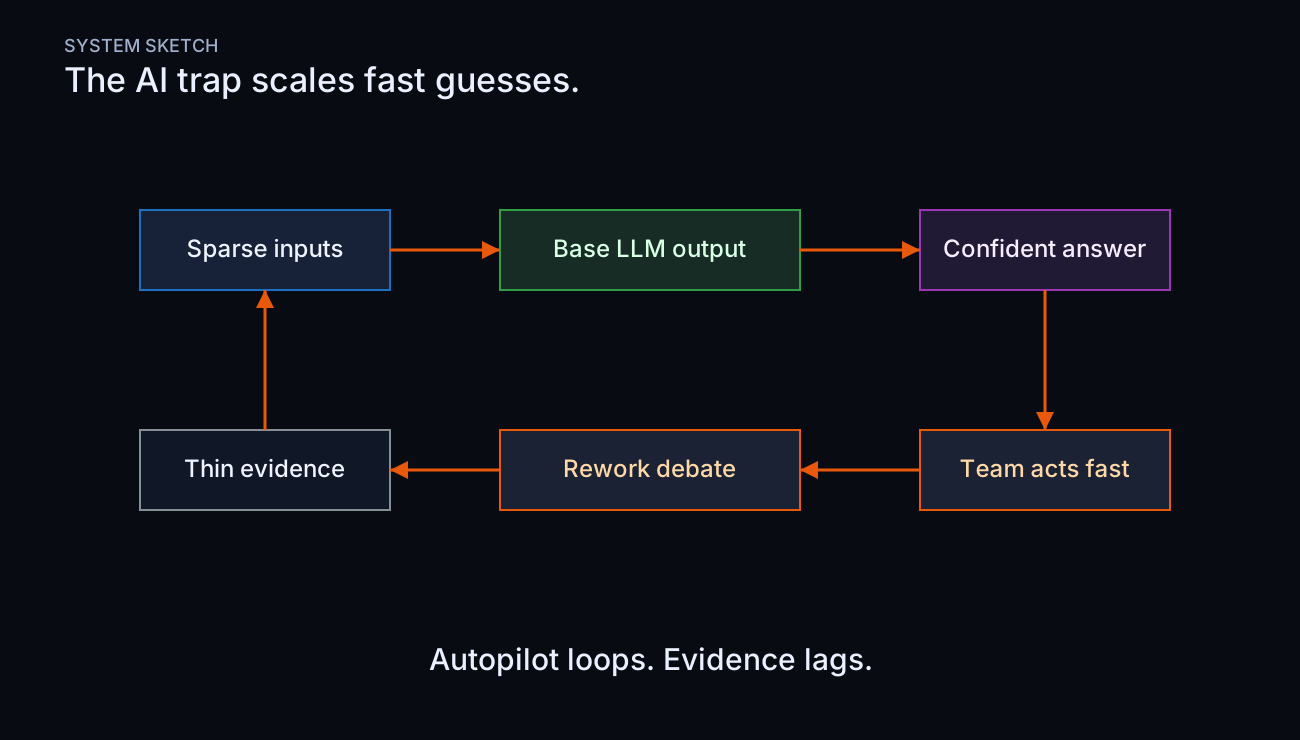
It is tempting to think that Artificial Intelligence will solve this cognitive bottleneck for us. But Large Language Models (LLMs) currently present a dangerous trap for innovators. Why? Because at their core, base LLMs are the ultimate Autopilot.
They function exactly like System 1: they are associative machines that instantly generate the most statistically probable patterns based on their training. Because they operate purely on WYSIATI, they naturally hallucinate, spinning highly plausible, confident stories out of limited or false data without pausing to doubt their own output. Historically, base models lack an intrinsic Pilot (System 2) to pause, evaluate multiple rules simultaneously, and rigorously verify the truth. If you rely on AI to do your thinking without an organizational framework to check it, you are simply scaling the flaws of the Autopilot.
The Startup Trap: Running Purely on System 1
The startup ecosystem celebrates System 1. We are told to trust our guts, move fast, and break things. But when you are searching for product-market fit or evaluating a new business model, relying purely on System 1 is dangerous.
Without a structured way to engage System 2, innovation teams fall into predictable traps: they keep key assumptions implicit, run experiments without clear decision criteria, and capture feedback as vague opinions rather than evidence-backed learnings. Because deliberate thinking takes so much energy, teams struggle to separate signals from noise and end up revisiting the same debates over and over.
In short: Teams confuse activity with progress.
Introducing SwiftCNS: An Organizational "System 2"
This exact gap is why we are launching SwiftCNS.
After years of collaborating with early-stage innovators, one pattern became impossible to ignore: learning is the single most important driver of progress. The faster a team learns, the faster it can make better decisions, and the faster it can win.
SwiftCNS is a dedicated learning system for innovation teams, designed to counteract our natural cognitive biases and do the heavy lifting of System 2. It gives teams a shared operating language to turn uncertainty into evidence, and evidence into action.
Instead of debating ideas in the abstract or relying on scattered memory, SwiftCNS guides teams through one rigorous core loop: Idea -> assumptions -> experiments -> insights -> decisions.
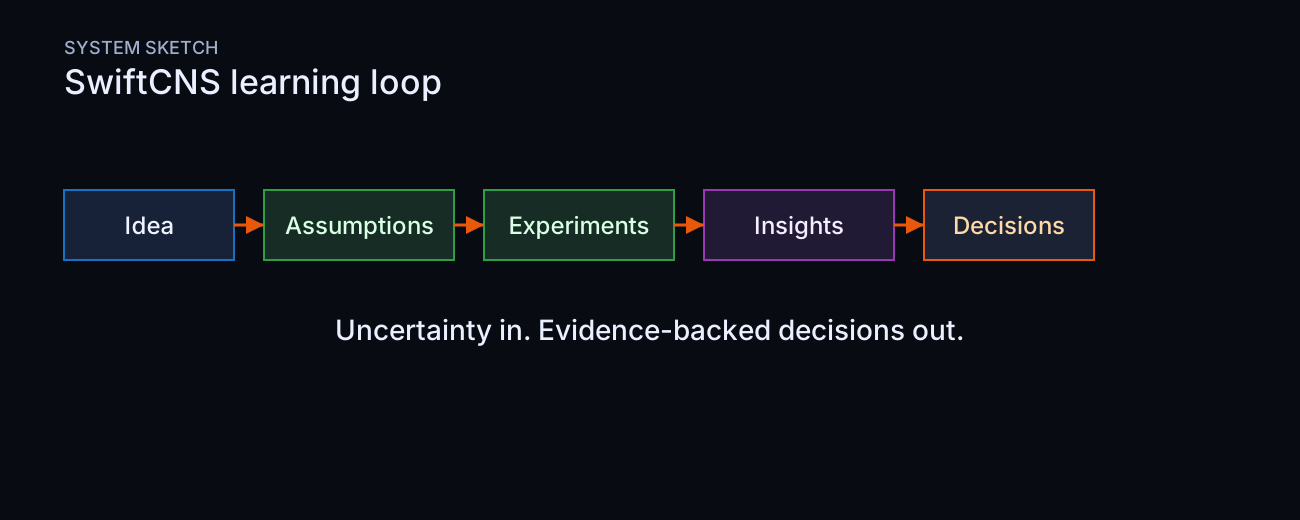
Here is how it bridges the gap between fast and slow thinking:
It breaks the WYSIATI habit: By requiring teams to explicitly map out their assumptions, SwiftCNS makes the bet visible so that it can be rigorously tested.
It demands evidence over opinion: It forces teams to capture measurable learnings rather than slide-ready summaries or vague validation.
It cures decision fatigue: By providing a structured path from insights to decisions, it stops teams from endlessly delaying choices due to ambiguous evidence.
Building is faster than ever. Learning is still the bottleneck.
Whether you are a founder at a pre-seed startup, a founder scaling an early-stage company, or a program manager running an accelerator, your success is measured by your learning velocity and decision quality. SwiftCNS doesn't just help you stay organized; it helps you learn faster, reduce rework, and make stronger decisions with less ambiguity.
If you're ready to improve learning velocity and decision quality, join SwiftCNS early access and use the Innovation Playbook to run the loop with your team.