Jun 12, 2026 · Insights
The AI-native company brain: how startups build operations that compound
 Hadi Ismail
We have spent the last several months talking to startups across Canada. Model access is everywhere. What surprised us is how uneven the rest of the stack is.
Most of the teams we meet are not building AI-native products yet. That gap makes sense. You need serious technical talent to embed models into what you sell, and that talent is scarce. But the same conversations exposed a different opening. AI-native operations, how the company runs day to day, is within reach for far more teams. The majority are not treating it as a competitive bet.
We expected more founders to wire frontier models into how decisions get made, how context persists, and how work compounds from one week to the next. Instead, someone opens a chat tab, asks a question, copies the answer into a doc, and closes the window. A Copilot lives inside one app. A teammate prompts a model in isolation and the rest of the company never sees the work. This is AI-augmented operations: useful in the moment, lossy by default.
The moment the chat closes, the context disappears. Every interaction is a one-off. Nothing accumulates. You pay for intelligence and throw most of it away.
There is a different shape. We call it AI-native operations, and the center of it is a company brain: durable shared memory that people and agents read from and write to. That is the compounding layer most of the startups we talk to skip while they optimize the wrong thing.
One distinction worth keeping straight. An AI-native product is what you sell. AI-native operations are how the company runs. In our conversations, innovators obsess over the first (which is great) and underinvest in the second. The second is where compounding advantage hides.
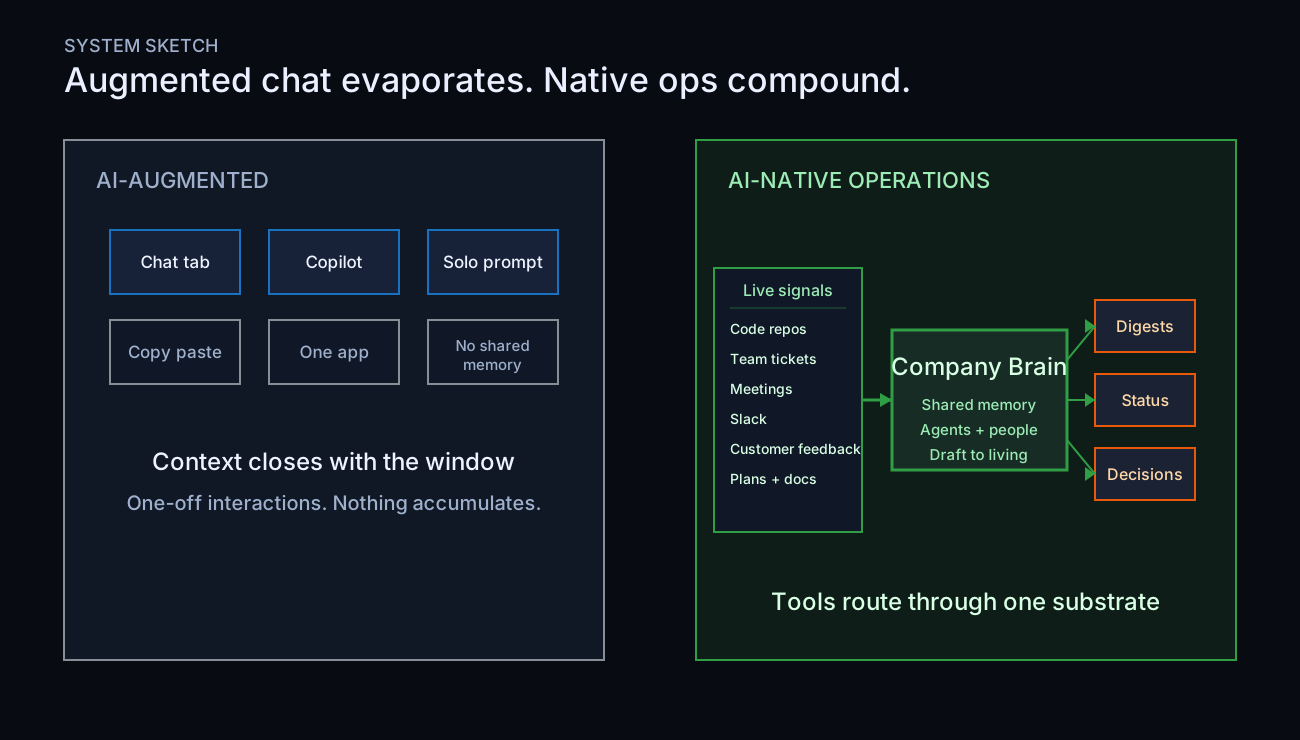
Open loops leak. Closed loops compound.
In the old pattern, a company runs as a series of open loops. A decision gets made, work happens, and context thins out at every handoff. Slack threads, meeting notes, and spreadsheets each hold a fragment. Nothing stitches them together.
AI-native operations run as a closed loop. Meetings, deploys, customer calls, and decisions route through an intelligent center that reads signals, writes drafts, and waits for human judgment before anything becomes canonical truth.
When operations are legible to agents, three shifts show up fast:
Less human middleware. You stop paying people to manually relay context from one tool to another. Every relay you remove is speed you keep.
More output per person. One operator with the right substrate and specialist agents can cover ground that used to require a standing meeting chain. Strong teams will happily run a higher AI bill than inflated headcount when the math works.
A structural startup edge. Incumbents carry legacy workflows and decades of "how we have always done it." A young company can design culture and tooling around compounding memory from day one. For teams still building toward an AI-native product, that operating edge is available now.
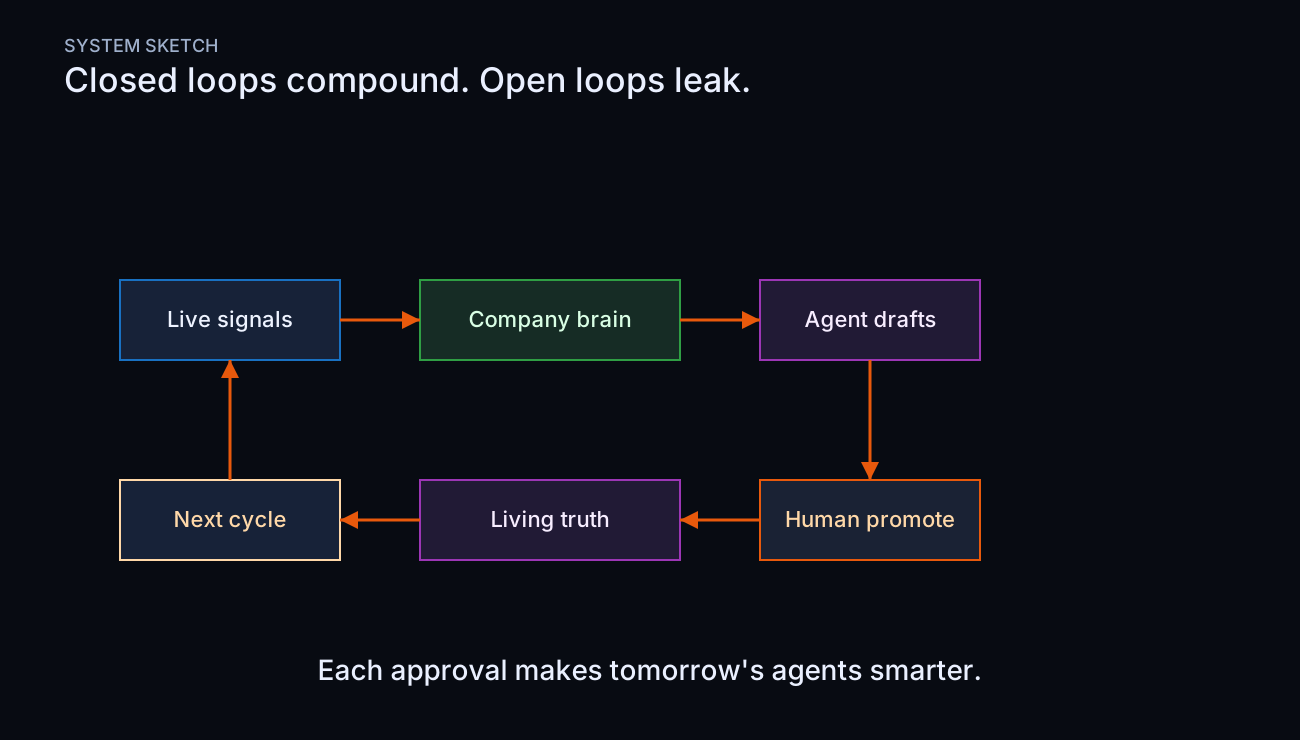
What a company brain is (and is not)
A company brain is not an employee-facing chatbot. It is not a search box over a folder of PDFs. Those are retrieval tricks, not operating systems.
A company brain is a decision substrate: versioned memory, live signals, governed agents, and human gates that turn noise into management-grade output people actually review.
Building one does not require a massive engineering program. It requires the right architecture. Even non-technical founders should prefer developer-grade foundations over consumer app shortcuts. Consumer tools feel easy on day one and hit a ceiling once agents need audit trails, diff history, and repeatable skills.
We run this stack at Swift Racks while we build SwiftCNS. The pattern below is portable. The vendors are swappable. The architecture is not. Under the hood, that means dual memory: canonical truth in Git, operational signal and agent state in a database.
Four layers that wire together
Think of the brain as four layers: memory, senses, workforce, gatekeeper.
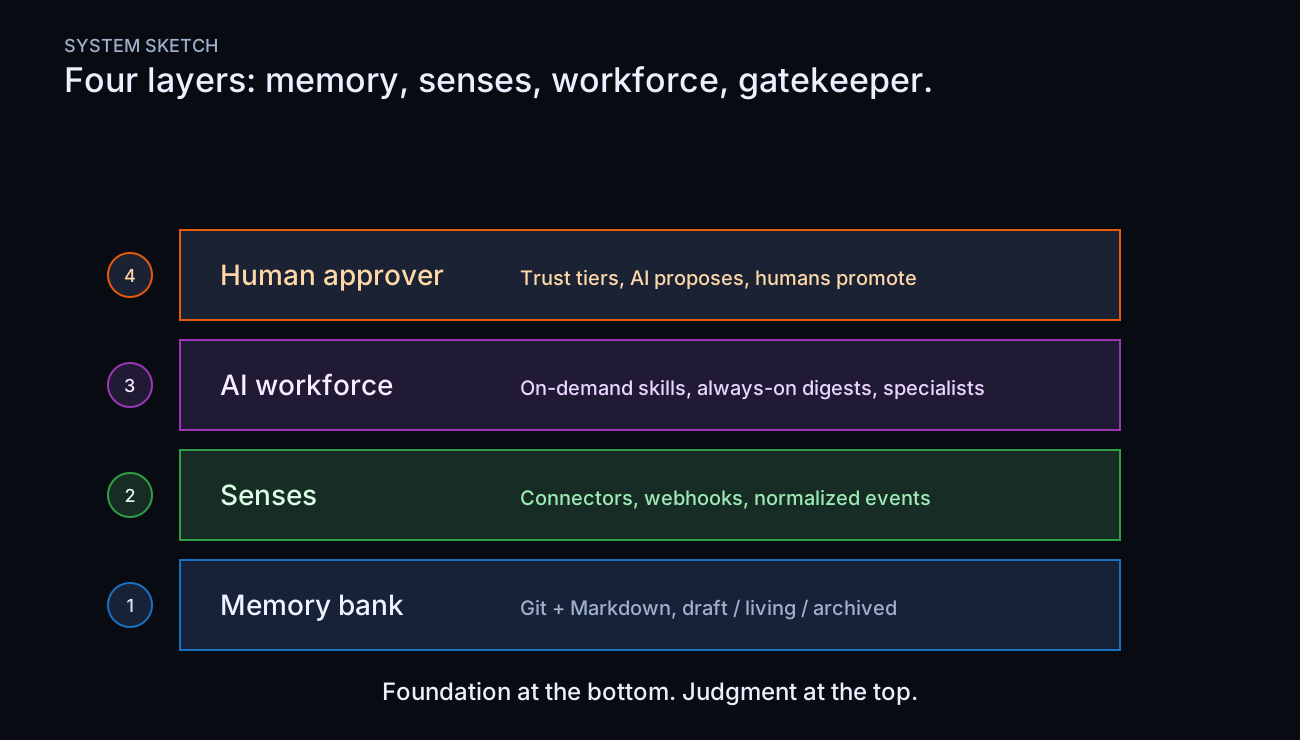
Layer 1: The memory bank
Job: Two stores that work together: canonical truth plus live operational state.
Pattern: Git plus Markdown for truth; Supabase or any Postgres-class database for signal and state.
Canonical store (Git + Markdown). Living truth, drafts awaiting promotion, audit trail. Git records every change: what changed, when, and who or what changed it. Markdown is easy for agents to read without misinterpretation. Agents propose changes via merge request; nothing becomes living truth until a human merges.
Operational store (Supabase or equivalent). Normalized events, agent run state, dedupe keys, and time-window queries ("what happened since yesterday?"). This is not where living truth lives. Agents query events here; humans promote truth into Git; merged canonical content loops back as indexed context.
We use GitLab for canonical truth and Supabase for signal and state. Postgres, PlanetScale, or a managed event store swap in; the split does not.
Notion or Google Docs can work for humans on the canonical side. They weaken the agent write loop and the audit story at scale. If you want compounding, optimize for machine-readable text and explicit lifecycle, not the prettiest editor.
Every canonical document carries a status: draft, living, or archived. Machines write drafts. Humans promote living truth. That rule alone prevents most "AI slop at scale" failures.
Layer 2: The senses
Job: Feed the brain what is happening across the company without someone manually copying context into ChatGPT.
Pattern: Connectors plus a normalized event format, routed through an always-on runtime catcher.
A webhook is an automatic messenger. When a feature ships, a deal closes, or a meeting ends, the source tool pings your brain. Typical sources: code hosts, meeting transcripts, Slack channels you designate, CRM notes.
Raw API payloads are messy and every tool speaks differently. On your always-on host, an ingestion worker polls or catches webhooks, normalizes signals into one schema (timestamp, source, actor, intent, confidence, payload, trace_id, dedupe_key), and persists them to the operational store. Scheduled agents on the same host (OpenClaw or equivalent) read those events and draft outputs. Agents query events, not fifty incompatible JSON shapes. High-frequency signals do not belong in Git.
Activate connectors in order of compounding: code and deploys first, then meetings, then comms, then work tracking and CRM. Partial coverage is fine if you say so. Silence about missing signal erodes trust fast.
Layer 3: The AI workforce
Job: Drafting and synthesis. Not one generic assistant. A team of narrow specialists.
Pattern: On-demand agents while you work, always-on agents while you sleep, both reading canonical Git and the operational store.
On-demand agents run inside your builder environment (Cursor, Claude Code, or equivalent). You invoke a skill: archive this decision, refresh this architecture map, synthesize this week's changelog. Output lands as a draft merge request or file in Git.
Always-on agents run on a small always-on host like OpenClaw. Each morning they can produce a standup digest, a weekly status draft, or a queue of decisions waiting on an owner. They read yesterday's events from the operational store while the team is offline, cross-check primary tools when ingest is still sparse, and open merge requests for intelligence drafts rather than writing living truth directly. Keep them disabled until ingestion has run cleanly for at least 48 hours.
Git receives proposals. Supabase receives signals and working state. Specialists usually fall into three classes: maintenance agents that refresh canonical docs, orchestration agents that produce leadership-facing summaries, and workflow agents scoped to one painful automation (action items from a meeting, deploy note to a channel).
Match the model to the job. Routine background synthesis does not need the most expensive frontier model. High-stakes drafting might. Treat models as swappable engines. The architecture is the durable bet.
Layer 4: The human approver
Job: Keep judgment human. Prevent autonomous rewrites of truth.
Pattern: Trust tiers plus a promotion step.
The rule is absolute: AI proposes, humans promote.
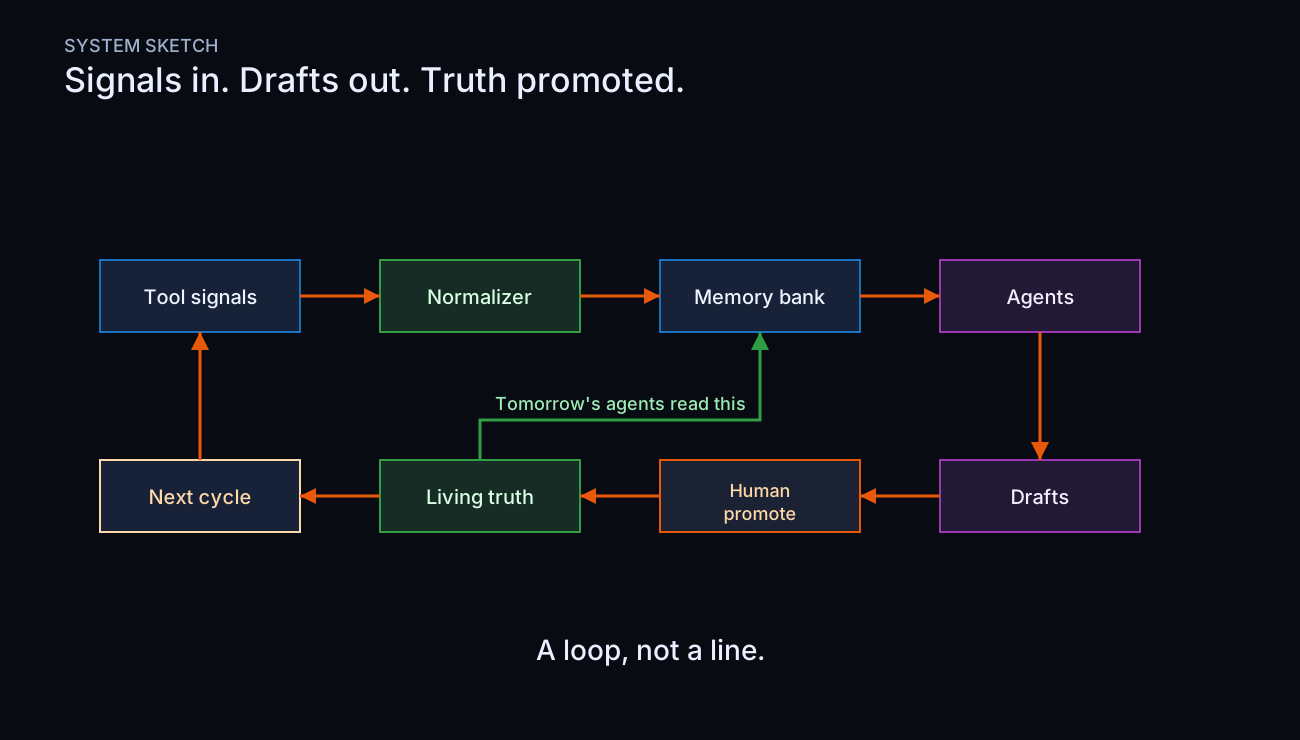
Every agent summary and substrate update starts as a draft. Nothing becomes living truth until a person reviews and merges in Git. On merge, a sync step updates the operational store so tomorrow's agents read promoted context, not stale signal. Decision proposals surface options and owners; leaders still sign off. That sign-off closes the loop and tells the system its output landed.
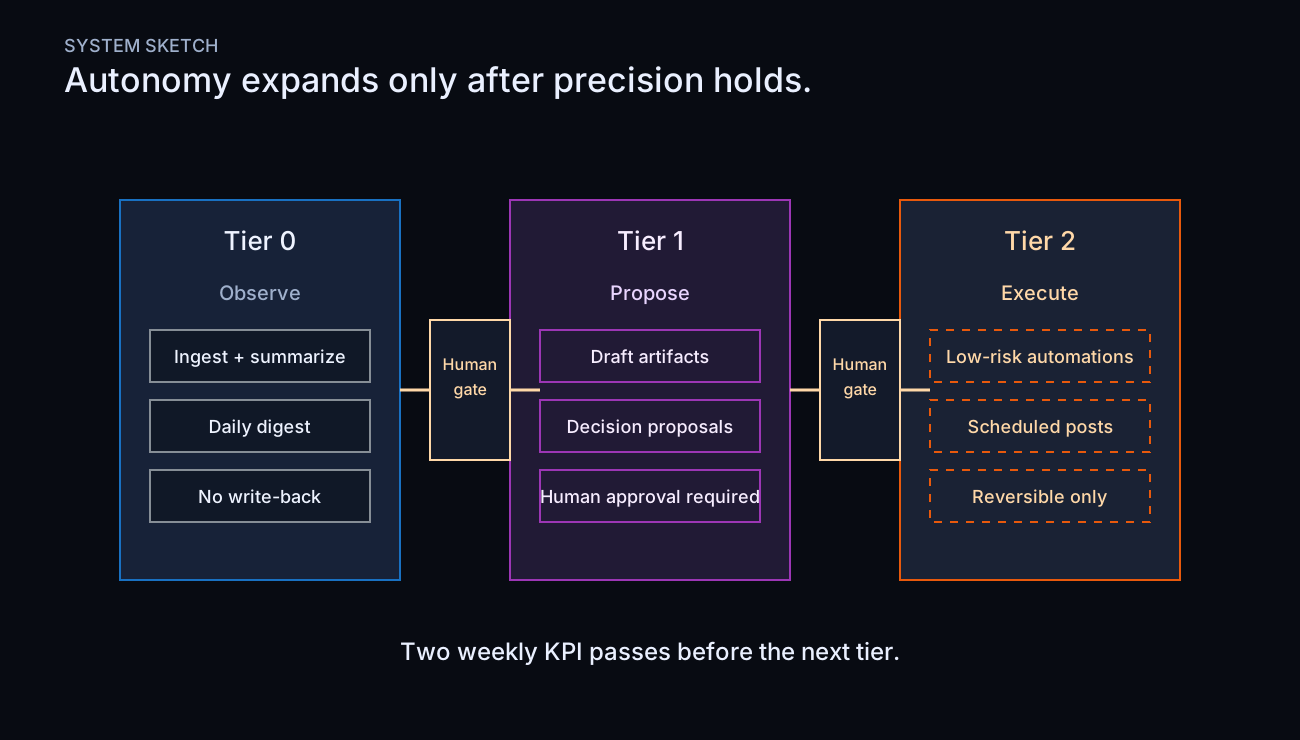
Start at Tier 0 (observe and summarize only). Move to Tier 1 (propose drafts) only after precision KPIs hold for two consecutive weeks. Tier 2 (low-risk reversible automations) comes last. Skip the sequence and proposals pile up unread until people stop opening the digests.
How the machine runs in one pass
- Your tools emit signals: code merges, Slack threads, meeting notes, calendar bookings, email threads.
- A small ingestion worker on your always-on host polls (or catches webhooks), normalizes everything into one schema, and writes to the operational database. We run ours every ten minutes on the same host as OpenClaw.
- On-demand and always-on agents read from the database and spot-check primary tools where ingest is still catching up, draft outputs, and open merge requests.
- A human reviews and merges what becomes canonical truth in Git.
- Merged canonical content syncs back to the database. Tomorrow's agents start sharper.
That last step is the whole point. It is a loop, not a line. Each cycle should leave the brain sharper than the day before.
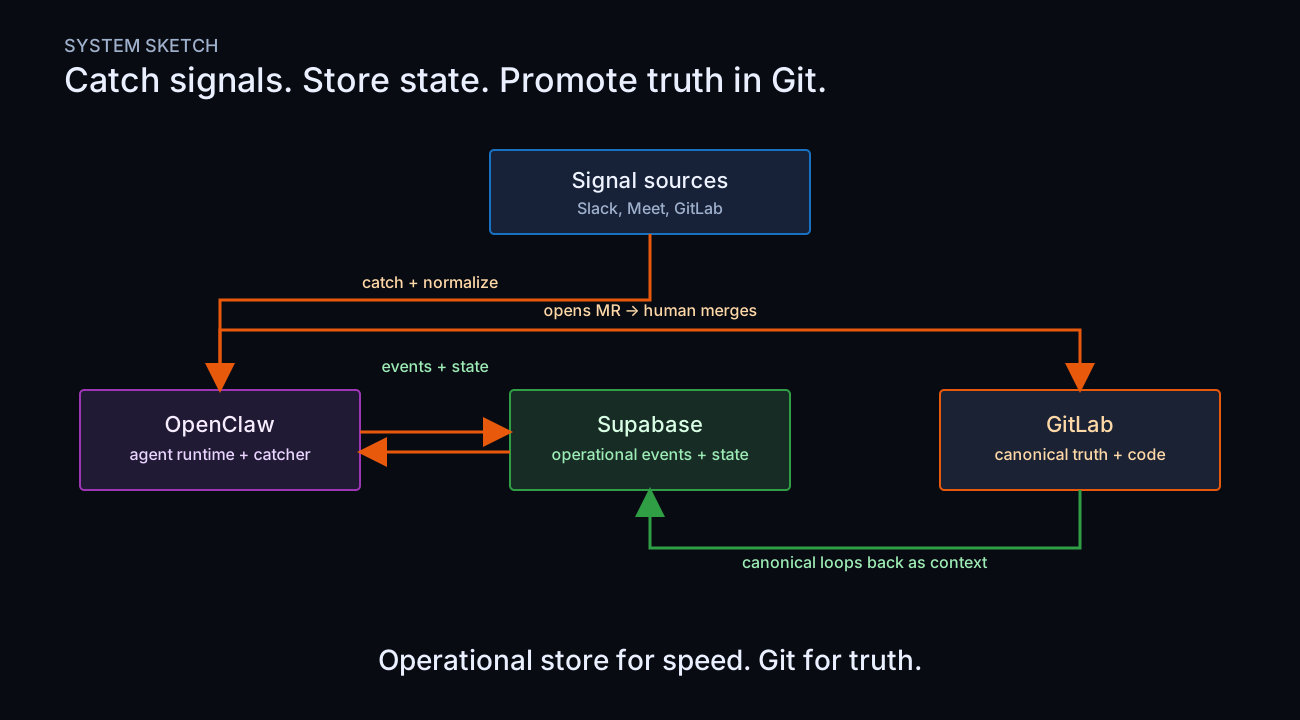
The diagram above is what runs where. The sketch below is the promotion lifecycle: signals through normalization, drafts, human promotion, and living truth feeding the next cycle.
What does it cost?
Founders usually ask two questions: what is the monthly bill, and who owns the setup? The monthly bill is smaller than most people expect. The harder part is making time to review what the AI drafts.
Hosting and tools (steady each month). Where your company's memory lives: a shared file store (GitHub or GitLab), a small database for recent activity, and a tiny always-on server that watches your tools while the team sleeps. Many startups begin on free plans. When you outgrow them, expect roughly $25–75/month for a team under twenty people.
AI usage (the part that moves). Pay-per-use when agents summarize your week, draft a standup, or help someone on the team during the day. Overnight summaries are the easy part to predict: often $30–150/month for a small team. Daytime use in tools like Cursor or Claude Code is the wild card. One technical founder might add $50–300/month. More activity means a higher bill. You set the ceiling. Use cheaper models for routine summaries. Save expensive models for work a human will actually read.
Your time (what makes or breaks it). AI proposes. You approve. Plan 5–10 hours in the first month to get the basics running. After that, 30–60 minutes a week to read drafts and promote what becomes official company truth. Skip that step and you are back to copy-paste chat.
| When | What you add | Hosting / month | AI bills (overnight jobs) |
|---|---|---|---|
| Week 1–2 | Shared memory, one or two tools wired in, one daily or weekly summary | $0–25 | $10–40 |
| Month 1–2 | Database, small server, more tools, more summaries | $25–75 | $40–150 |
| Month 1–2, heavy daytime use | Same hosting, team using AI assistants all day | same | +$50–300+ |
These are ballpark numbers for a Canadian seed-stage startup in 2026. You already pay for Slack, Google Workspace, and probably some ChatGPT or Copilot seats. The brain does not replace those. It connects them so context stops disappearing.
You decide how big to build. The table shows a full setup, not what you need on day one. Some teams go deep on AI workflows and the API bill grows. Add pieces when you can afford them. Even step one alone, one shared place for company memory and a simple rule that humans approve before anything goes live, is worth more than it costs. You do not need overnight agents to get value.
Kickstart: plan your company brain in one session
You do not need to implement all four layers this week. You do need a plan that respects closed loops, dual memory, trust tiers, and human promotion.
Copy the prompt below into Claude, Codex, ChatGPT, or Cursor (new chat or project). Answer the discovery questions it asks, then work through the phased plan it produces. The prompt encodes the architecture from this post: dual memory, ingestion worker plus agent gateway, connector order, trust tiers, enable gates, cost buckets, and a start-small path when you are not ready for the full stack.
Download the prompt as Markdown if your tool handles file upload better than paste.
Copy the full planning prompt
You are an AI-native operations architect. Help me design a **company brain** for my startup: a compounding operating layer with durable shared memory, live signals, governed agents, and human promotion gates.

This is **AI-native operations** (how the company runs), not AI-native product (what we sell). Do not recommend "add Copilot seats" or a generic employee chatbot. Do not treat RAG over PDFs as a company brain.

## Non-negotiable principles

1. **Closed loop, not open loop.** Signals → operational store → agent drafts → merge request → human merge → canonical truth → sync back as context → better agents tomorrow.
2. **AI proposes, humans promote.** Machines write `draft`. Nothing becomes canonical truth without a named human reviewer who merges in Git.
3. **Document lifecycle:** every artifact is `draft`, `living`, or `archived`. Never skip the promotion step.
4. **Trust tiers (do not skip):**
   - **Tier 0 — Observe:** ingest, classify, summarize only. No write-back.
   - **Tier 1 — Propose:** create draft artifacts and proposals. Human approval required.
   - **Tier 2 — Execute:** low-risk, reversible automations only after Tier 0/1 KPIs pass for two consecutive weeks.
5. **Connector order (activate in this sequence unless my company type clearly differs):**
   1. Code / PRs / deploys (product teams)
   2. Meeting notes / transcripts / calendar (Google Meet + Drive, Zoom, Fireflies, etc.)
   3. Comms (Slack/email in agreed channels only)
   4. Work tracking (Jira, Linear, Asana)
   5. CRM (HubSpot, Salesforce)
   6. Call intelligence (Gong, etc.)
   Partial coverage is fine. Every plan must include a **degraded signals** section listing what is missing and estimated coverage %.
6. **Dual agent runtime:** on-demand agents (while builders work) + always-on agents (scheduled digests while the team sleeps). Both read canonical Git and the operational state store.
7. **Three agent classes (not one generic assistant):**
   - **Maintenance:** refresh canonical docs from live systems (weekly or on change)
   - **Orchestration:** leadership-facing synthesis (standup, weekly status, customer voice themes, decisions queue, drift checks)
   - **Workflow:** 2–4 narrow automations for felt pain (meeting notes draft, action items from a meeting, deploy notes, CRM moment filing)
8. **Normalized events:** connectors map inbound signals to one schema (`trace_id`, `timestamp`, `source`, `actor`, `intent`, `confidence`, `payload`, `links`, `dedupe_key`). Agents query events from the operational store, not raw API shapes. Failed rows go to a dead-letter table, not silent loss.
9. **Intelligence output rules:** provenance on every claim, explicit confidence, no invention when data is missing, audit trail (data window, connectors queried). Log each agent run to an `agent_runs` table (started/completed, connectors queried, output path).
10. **Prefer developer-grade foundations** over consumer shortcuts when the team can support it (version history, diff, repeatable agent skills). If the team is non-technical, recommend the lightest substrate that still supports lifecycle and audit — and say what breaks at scale.
11. **Dual memory:** canonical truth in Git (merge request + human promotion); operational signal and agent state in Supabase or any Postgres-class database. Never write high-frequency events or agent run state into Git.
12. **Two always-on jobs on the host (do not collapse these):**
    - **Ingestion worker:** poll or webhook → normalize → operational store (runs on a timer, e.g. every 10 minutes). Examples: a small Node service, n8n poll workflow, or event-bridge pattern.
    - **Agent gateway:** scheduled crons that read the operational store, cross-check primary sources when ingest is still catching up, draft outputs, and open merge requests. Examples: OpenClaw crons, CI scheduled jobs, or a lightweight worker with LLM calls.
13. **Safe rollout gates:**
    - Keep scheduled agents **disabled by default** until ingestion has run cleanly.
    - Enable first digest only after **48 hours of events** in the operational store (or an explicit degraded-signals plan if shorter).
    - Enable Tier 1 proposal crons only after Tier 0 KPIs pass for two consecutive weeks.
    - Agents must **dual-read** during rollout: query the operational store AND spot-check primary tools (code host, Slack, docs) so sparse ingest does not produce thin summaries.
14. **Scope is my choice:** I can start with Git memory + human promotion only and add ingestion, database, and overnight agents when budget and owner time allow. Even that foundation compounds. Do not prescribe a full stack on day one unless my answers show I am ready.

## Phase 1 — Discovery (ask me these before planning)

Ask me these questions one section at a time. Wait for answers before Phase 2.

**Company**
- Company name, stage, headcount, and primary business model
- Who will own the company brain (name/role)?
- Technical depth on the team (no engineers / one technical founder / eng team)

**Pain**
- Where does context die today? (list tools and handoffs)
- What recurring meetings exist only to relay information?
- Biggest trust risk if AI drafts ops output without review?

**Current stack**
- Code host (GitHub, GitLab, none)
- Docs/knowledge (Notion, Google Docs, Confluence, Git+Markdown, other)
- Comms (Slack, Teams, email)
- Meetings (Google Meet + Drive, Zoom, Fireflies, other)
- Work tracking and CRM if any
- Operational database (Supabase, Postgres, none)
- Always-on host (OpenClaw, small VPS, cron worker, none)
- Where AI is used today (ChatGPT, Copilot, Cursor, Claude, other)

**Constraints**
- Monthly budget for hosting (steady costs)
- Monthly budget for AI API usage (overnight jobs vs daytime builder use)
- Compliance or data boundaries (customer data, PII, regulated industry)
- Time budget for setup (hours per week for first 30 days)

## Phase 2 — Produce my plan

After discovery, output the plan in this exact structure:

### 1. Executive summary (5 sentences max)
What we are building, why it compounds, what we are explicitly not building, and whether we start full-stack or foundation-only.

### 2. Current state vs target state
| Area | Today (lossy pattern) | Target (closed loop) |

### 3. Memory recommendation (Layer 1 — Dual store)
- **Canonical substrate:** Git+Markdown (or substitute) with folder taxonomy, frontmatter schema (`draft` / `living` / `archived`), truth hierarchy, week-1 steps
- **Operational state store:** Supabase/Postgres-class DB with tables sketch:
  - `events` (normalized signals + `dedupe_key`)
  - `agent_runs` (cron audit: status, connectors queried, output path)
  - `canonical_context_index` (pointers/snippets after human merge)
  - `dead_letter_events` (failed normalizations)
- Auth model and where secrets live (host env, CI variables — never in docs)
- Explicit rule: what lives in Git vs what lives in the operational store

### 4. Signal ingestion plan (Layer 2 — Senses)
- Connector activation table: priority, tool, pattern (webhook / poll / ingestion worker), what lands in operational store vs what files in Git only after human promotion, trust tier at launch
- Normalized event schema sketch for my stack (example JSON for two signal types, including `dedupe_key`)
- **Ingestion worker** spec: poll interval, env vars, smoke-test command, dead-letter behavior
- **Agent gateway** spec: which crons exist, default disabled, enable gates (48h buffer, KPI thresholds)
- Auth model: bot/service identity, secret storage, minimum scopes
- **Degraded signals** block for what we will not have on day one (with estimated coverage %)

### 5. Agent workforce plan (Layer 3)
- **On-demand:** where builders run agents (Cursor, Claude Code, IDE, CLI) and 3 starter skills to define first
- **Always-on:** host option matched to my technical depth; list crons disabled-by-default
- **MR-based write path:** always-on agents open merge requests for drafts; never write `living` truth directly
- **Dual-read rule** during rollout: which primary sources each cron must still check directly
- Agent catalog table:

| Agent name | Class | Cadence | Inputs | Output location | Trust tier | Enable gate |

Include at minimum: one maintenance agent, two orchestration agents (daily standup + weekly status), one workflow agent scoped to my top pain (often meeting-notes draft or action-item extraction).

- Model matching guidance: cheaper models for Tier 0 observe jobs; frontier models only for drafts a human will read
- API spend ceiling recommendation (overnight jobs vs daytime builder use)

### 6. Human gatekeeper plan (Layer 4)
- Named approvers for promotion to `living` via Git merge
- Canonical → operational sync step after merge (how promoted Git content indexes back)
- Tier 0 → Tier 1 → Tier 2 rollout with KPI targets:

| KPI | Target | How to measure |

Default targets if I have no baseline: alert precision ≥80%, actionability ≥70%, weekly status on schedule 100%, duplicate artifact rate ≤10%.

- Review cadence (weekly KPI, monthly trust-tier review)

### 7. Intelligence outputs (what leadership reads)
Minimum folder structure under `intelligence/` (canonical Git, draft until merged):
- `standups/`, `status/`, `customer-voice/themes/`, `customer-voice/moments/`, `decisions-queue/`, `drift/`, `coordination/prompts.md`

For each output type, specify: cadence, owner, required sections (including **Degraded signals** when data is missing), draft-only rule.

### 8. Phased roadmap

**Week 1 (foundation — required even if non-technical):** (3–5 tasks, one owner each) Git substrate, promotion owner named, first folder taxonomy, optional first connector or manual signal filing

**Days 8–30:** operational store + ingestion worker + first orchestration agent (disabled until 48h events or explicit degraded plan)

**Days 31–90:** enable Tier 1 proposal crons if KPIs pass; add workflow agent #2; canonical sync-back live

Each phase must list **verification steps** (smoke-test insert to `events`, one manual cron run, one draft MR reviewed).

### 9. Cost and scope (plain language)
Three buckets matched to my budget answers:
- **Hosting and tools / month** (Git host, database, always-on server)
- **AI usage / month** (overnight jobs predictable; daytime builder use variable)
- **Owner time** (5–10 hours month one; 30–60 min/week steady state)

Include a **start-small** row: what I get from Git memory + promotion ritual alone before any overnight agents.

State clearly: I control how extensive this gets. The full plan is not a day-one minimum.

### 10. Risks and anti-patterns to avoid
Flag if my plan includes: unread draft piles, missing promotion owner, skipping Tier 0, enabling crons before ingest works, Supabase-only summaries without dual-read, silent missing connectors, one monolithic "do everything" agent, autonomous rewrites of truth, or high-frequency events committed to Git.

### 11. Next actions (tomorrow morning)
Three concrete actions I can take in under 2 hours total. At least one must be doable without a technical cofounder (e.g. name promotion owner, create Git repo + `draft`/`living` rule, list degraded signals honestly).

## Rules for your response

- Be specific to my answers. No generic "use AI more" advice.
- Vendors are swappable (OpenClaw, Supabase, GitLab, Cursor are examples); architecture is not.
- When I am non-technical, give plain-language glosses for webhook, Git, schema, normalized events, operational store, ingestion worker, and merge request.
- When I am technical, include example env var names, poll intervals, cron schedules, dedupe key patterns, and one sample agent skill prompt.
- End with: "What would you like to refine — scope, substrate, connectors, or agent catalog?"

Begin with Phase 1 discovery questions now.
What to do next
Most of the startups we talk to are still running disposable chat. You do not have to. Give your company one shared memory, wire your tools into it, and let agents draft while humans promote what becomes truth. For the evaluation loop innovation teams run on top of that substrate, see Why moving fast isn't enough.