When building takes an afternoon, deciding becomes the work
 Hadi Ismail5 min read
SwiftCNS is now open to everyone. This is why we built it, and what our early access taught us first.
Your team can build an idea in an afternoon now. Agents write the code, build the page, run the test and pull the numbers. Work that used to take a quarter takes a week.
Building used to be the slow part, so it set the pace. Deciding what to try, measuring whether it worked and choosing what comes next all had time to happen around it. Not anymore.
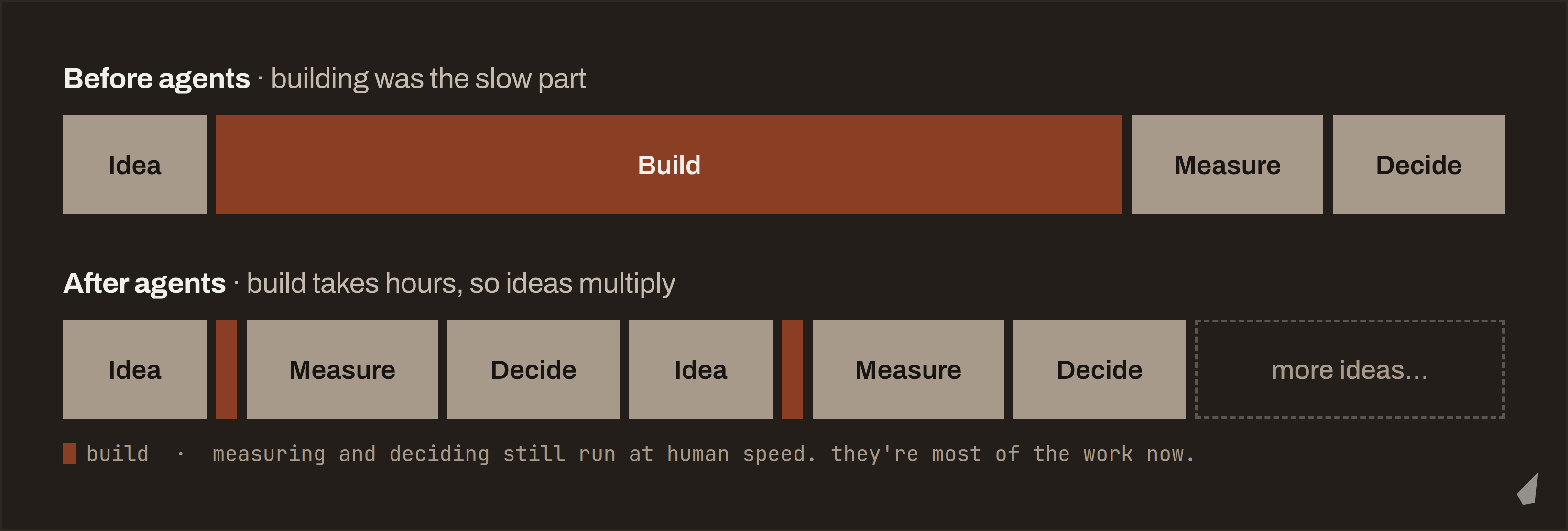
When build takes hours, ideas multiply. The steps around it still run at human speed, and now they are most of the work.
Three new problems
Volume. More ideas get tested, so more decisions get made. Dozens a week, across your team and your agents, most of them in a chat window. Nobody can keep track of that many from memory.
Speed. Decisions now come in days, not quarters. Each one should build on the last learning. If that learning lives in a chat that has scrolled away, the next idea starts from scratch.
Delegation. Agents now make calls and carry out ideas. If nobody set what success looks like before they ran, nobody knows which ones worked.
Move this fast without a record and you don't compound what you learn. You repeat it.
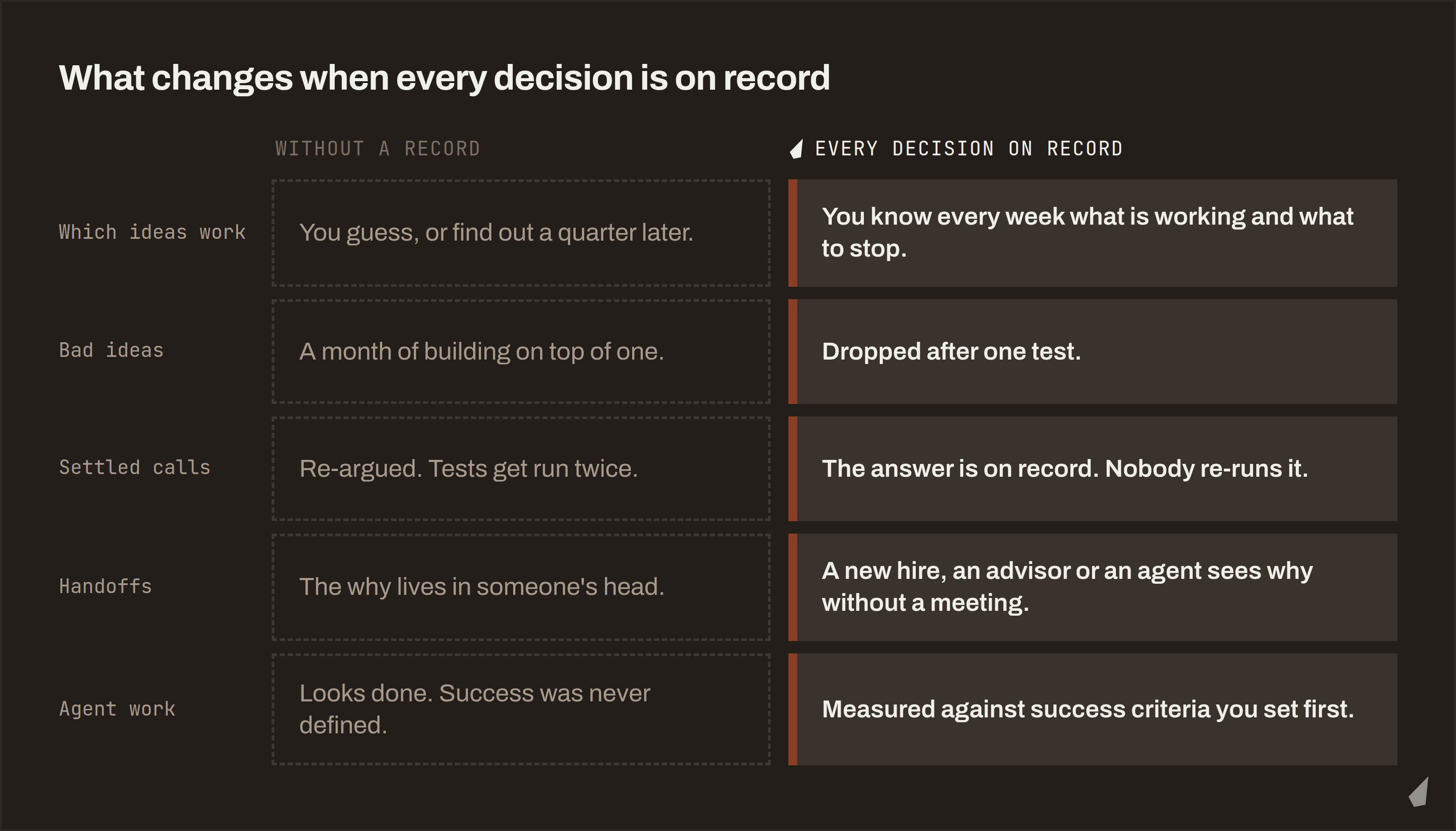
Here's what changes when every decision is on record:
What early access showed us
Startups and corporate innovation teams used SwiftCNS through our early access program. They split cleanly in two.
Teams moving at human speed made a handful of decisions a week, mostly in meetings, and everyone knew why. Writing down evidence felt like paperwork, so they decided on instinct. For them that was a fair call.
Teams building with AI ran ideas through ChatGPT and Claude all day and shipped fast. But what they learned stayed in the chats, so each new idea started from scratch.
Seed-stage startups looking for product-market fit felt it most. They were testing pricing and channels while still working out who the customer is, and every wrong guess cost weeks. They needed to know, every week, what was working and what to stop.
A record that keeps up
That is what we built SwiftCNS to do. SwiftCNS is decision infrastructure for teams building with AI: test an idea against success criteria set up front, decide on evidence, and keep every decision on record.
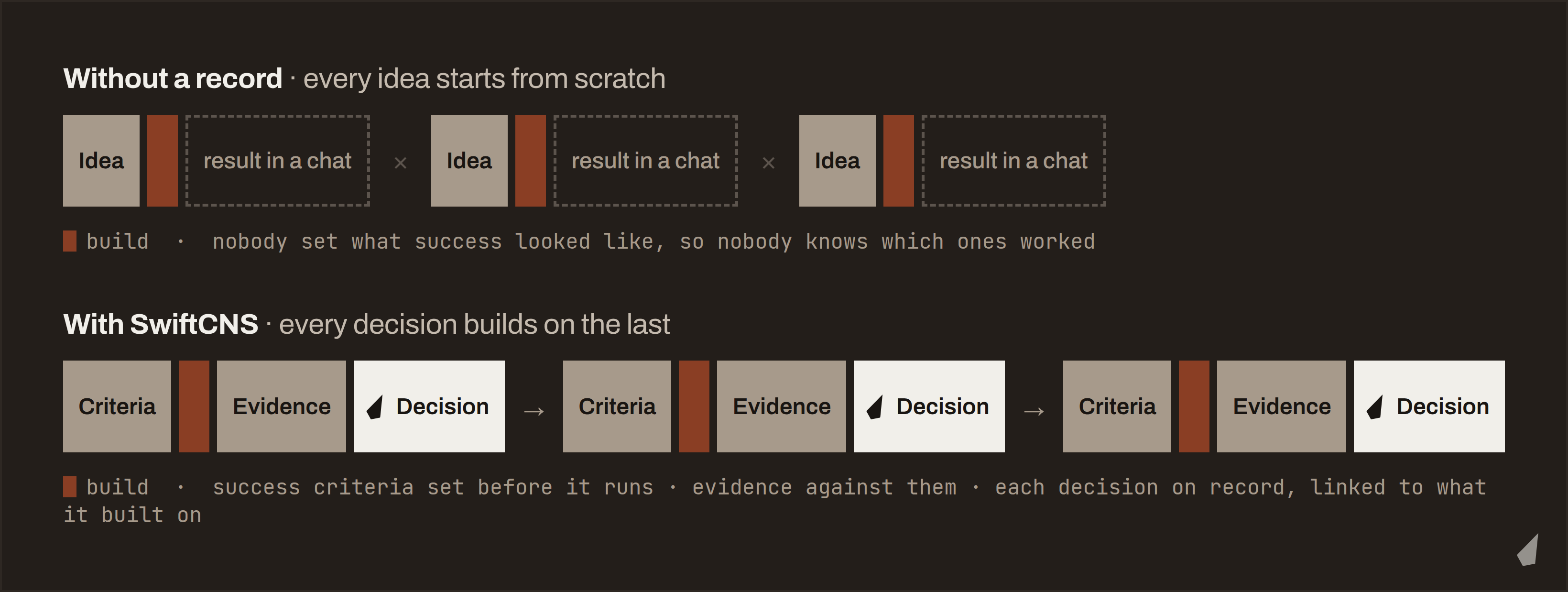
Every idea gets success criteria before it runs, and they can't move after. The results are measured against them, whether your team ran the test or an agent did, so you know what is working and what isn't. The decision goes on record with what you assumed, what counted as success, what happened and who decided. Each record links to what it built on, so your next decision starts from your last one, whether a person or an agent picks it up.
It all happens in the chat you already have open. SwiftCNS works inside Claude, ChatGPT, Cursor, Claude Code and Codex. A team moving at AI speed won't open another app to log a decision, which is why we launched inside the AI tools first.
Here is what one looks like: our call on who SwiftCNS is for, recreated as a Decision Record for this post. We made that call from early access conversations, not a formal experiment, so the success criteria shown were written after the fact. From here on, ours are set before the results come in.
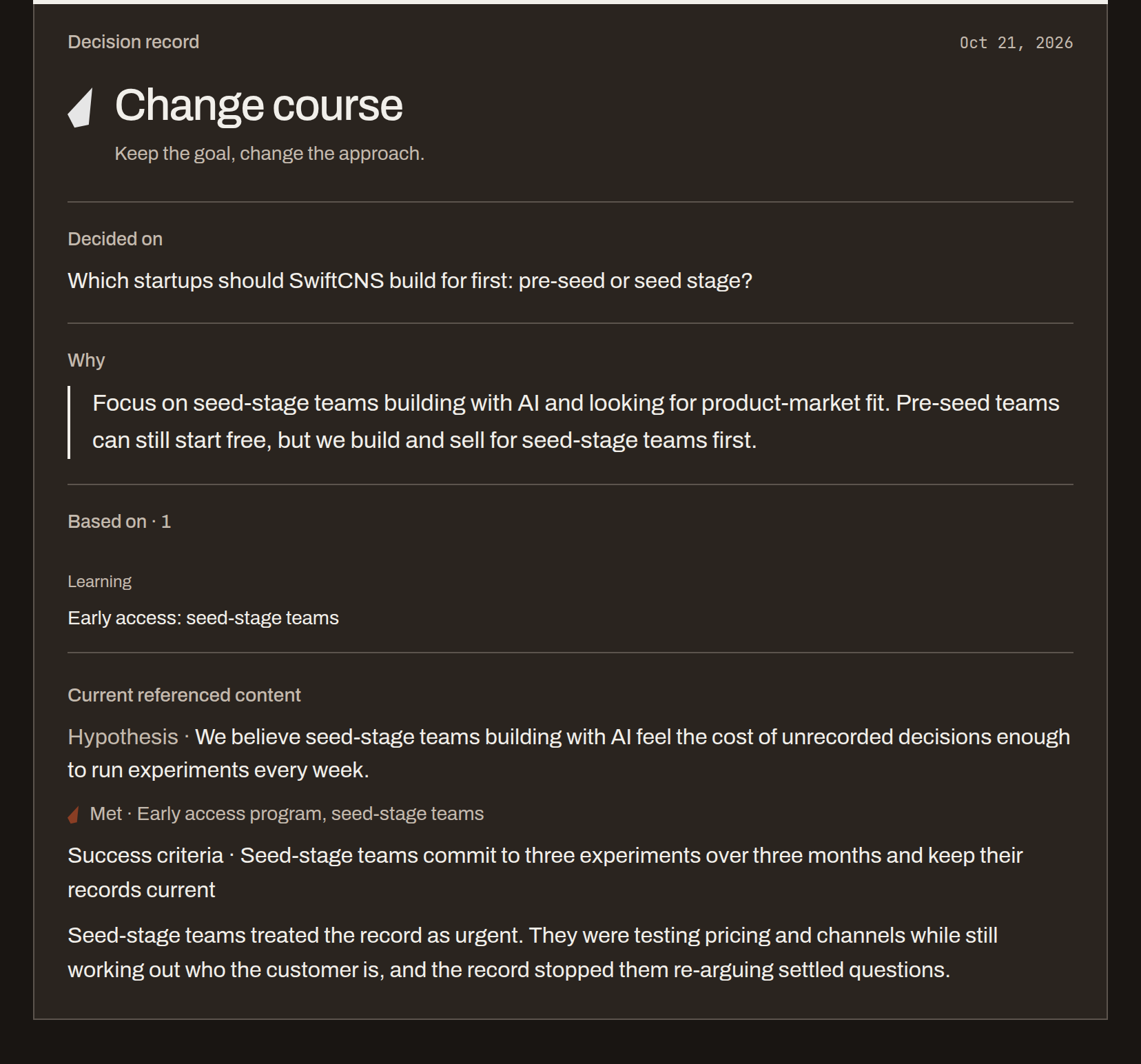
SwiftCNS is built for seed-stage teams first. Pre-seed teams can still start free.
Start a decision record this week
You don't need SwiftCNS to start. You need a habit that keeps up with how fast you move. These five steps are the start, and how to test an idea before you commit covers the full method.
- Write the success criteria first. Before a test runs, write down the result that means go ahead and the result that means stop. Then don't touch it.
- Keep the record where you work. If logging a decision means opening another tool, it won't happen.
- Link each decision to what it built on. The experiment, the learning, the earlier call. That is what lets the next idea start ahead.
- Measure what your agents run. Give every idea an agent carries out the same success criteria you would set for your own, and point it at what has already been decided.
- Count a killed idea as a result. Write down what the evidence showed, then move on.
We hold ourselves to the same standard, in public. Our own go-to-market runs as experiments in SwiftCNS, and we'll share some of them as we go: what we tested, what counted as success, what happened and what we decided. Including the ones that don't work.
Your turn
SwiftCNS is now open to everyone. Start on the Free plan, connect the AI tool you already use, and take one idea to a decision. When your team is testing ideas every week, upgrade to Team. No credit card required.
What's the biggest call your team is about to make on instinct? That's a good first one to test.
Follow along on LinkedIn and X to see what we test next, and what we decide.